When “Parental Alienation” Silences Abuse
- Deanna Newell
- Apr 11
- 2 min read
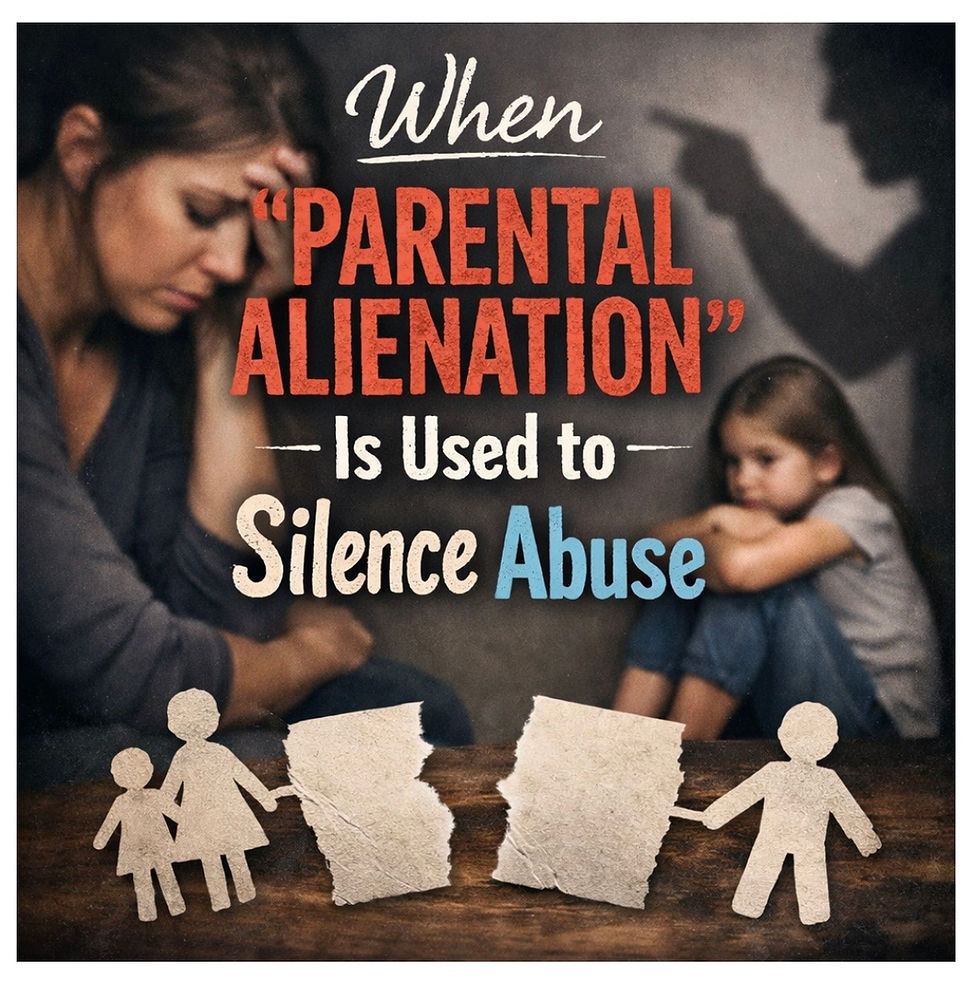
“When labels replace evidence, the truth gets lost — and children live with the consequences.”
Parental alienation is serious, but misused, it can hide abuse and put children and survivors at risk.
Few issues in family law are as complex, or as contested, as parental alienation.
At its core, it refers to behaviours that damage a child’s relationship with a parent. Where it exists, it can cause real harm: disrupted attachment, long-term emotional distress, and fractured family bonds.
But there is growing concern that in some cases, the concept is being misapplied, particularly where domestic abuse is present.
Dangerous Overlap
Research shows that up to 90% of family court child arrangement cases involve domestic abuse, including coercive or controlling behaviour.
And yet, allegations of parental alienation sometimes appear in these same proceedings, creating a critical challenge:-
Protection can be reframed as hostility
Abuse can be reframed as conflict
Survivors can be reframed as the problem
Studies show that misinterpreting protective parenting as alienation can result in children being returned to unsafe environments, compounding trauma.
Financial Alienation
Parental alienation can also take the form of financial manipulation, sometimes called “financial alienation”. One parent may use:-
Overnight arrangements to maximise child maintenance
Disputes over payments to maintain leverage
Financial control to dominate the other parent
Since Covid-19 and the cost-of-living crisis, children are increasingly caught in the crossfire of adult conflicts, suffering both emotional and financial harm.
Coercion Has No Gender
Coercive and controlling behaviour is not limited to mothers or fathers. It is about patterns of behaviour, not identity. Courts must be equipped to recognise patterns objectively, regardless of who it comes from.
The Cost of Getting It Wrong
When courts confuse:-
Genuine parental alienation, and
Protective parenting in response to abuse
…the consequences are severe:-
Survivors are silenced
Abuse goes unrecognised
Children are placed at risk
Balance is essential: children cannot be used as pawns in adult conflicts.
Evidence & Transparency
The solution is not to reject one concept for another, instead it is necessary to strengthen the system through:-
Evidence-driven decisions
Examination of patterns, not isolated claims
Considering emotional and financial realities together
A structured, evidence-based framework would:-
Increase transparency
Produce better-informed decisions
Deliver fairer outcomes for children
Statistics That Matter
Up to 90% of child arrangement cases report domestic abuse – Women’s Aid / Ministry of Justice 2023
Misidentifying parental alienation can contribute to unsafe child contact arrangements and poorer outcomes for victims of domestic abuse – UK Domestic Abuse Commissioner / Family Court Review
60% of high-conflict separations involve economic abuse – Surviving Economic Abuse Report 2022
The Hard Truth
This is not about choosing sides. It is about ensuring:-
Abuse is never minimised
Allegations are never weaponised
Children are never caught in the crossfire
Because when the system fails, the long-term cost is carried by children, far beyond the courtroom.
DN Family Law - fighting for fairness, safety, and children first.
Deanna Newell Family Law
Advocacy for truth-tellers, survivors, and the children who deserve better


