Child Maintenance Is Not Working, And Everyone Knows It
- Deanna Newell
- Apr 26
- 3 min read
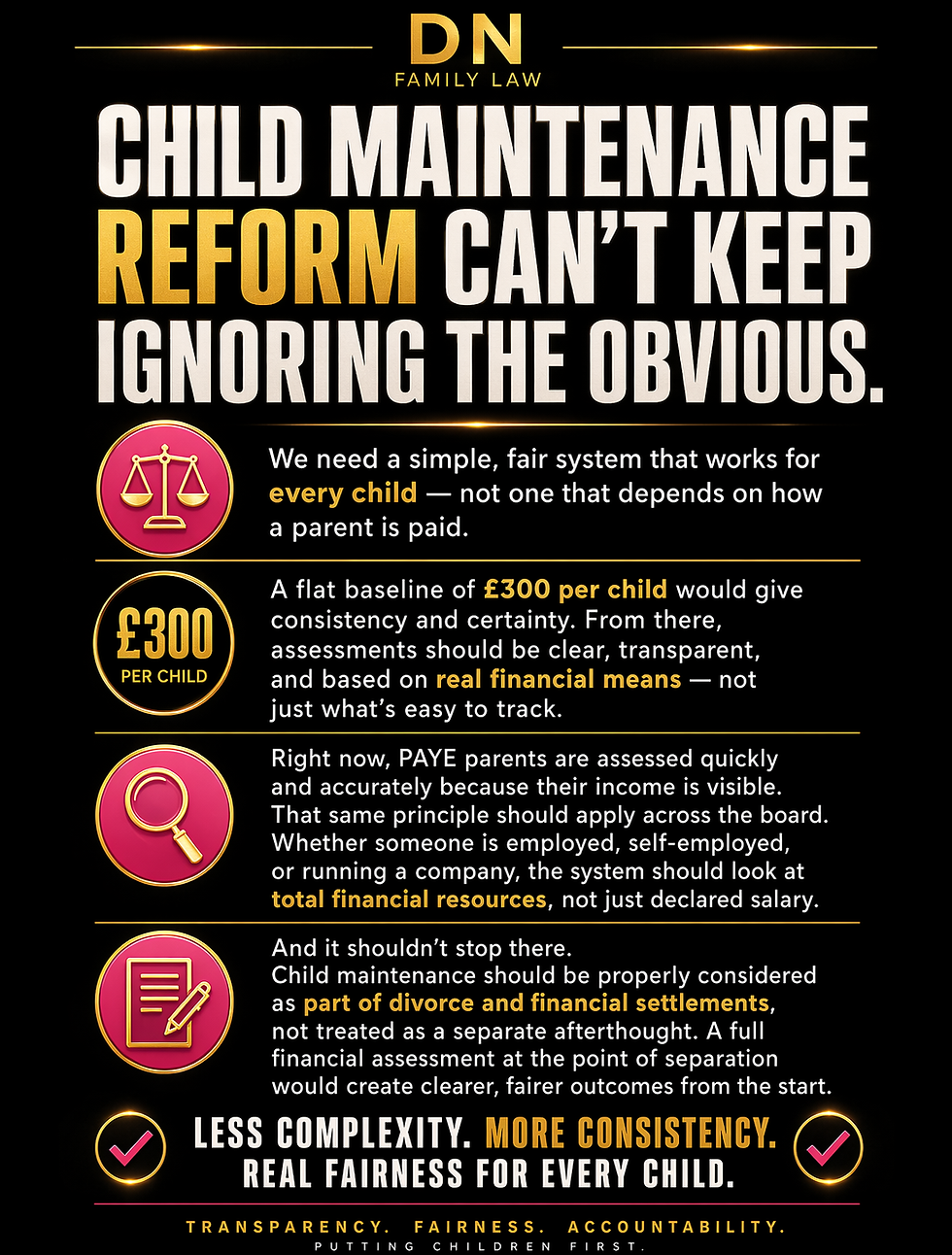
Let’s stop pretending the system is fair.
Child maintenance in the UK is inconsistent, outdated, and heavily dependent on how income is structured, not what someone can actually afford.
PAYE? Straighforward income? Self-employed income? Complicated income? Company income? The reality is the same, however the treament is different. And children are the ones paying the price for it.
Let’s stop pretending the child maintenance system is working.
It isn’t.
It’s inconsistent. It’s confusing. And worst of all, it depends too much on how someone earns money, not what they actually have.
That is not fairness. That is a loophole-heavy system dressed up as justice.
Children don’t care how income is structured. They care whether their needs are met.
And yet the system often produces completely different outcomes for families in similar situations, depending on whether income is PAYE, self-employed, or routed through a company structure.
The same reality, and yet the treatment by the Child Maintenance Service is different.
That alone should be a warning sign.
The system is stuck in the past
The modern economy is not simple.
People are not all paid through neat monthly salaries anymore.
And yet the child maintenance system still behaves as if they are.
That gap between modern financial reality and outdated rules is where confusion, disputes, and mistrust thrive.
And it is children who feel the consequences.
A simple starting point: a baseline per child
There is a straightforward way to bring clarity back into the system:-
Introduce a clear, transparent minimum contribution per child.
For example: £300 per child as a baseline.
Not a cap. A starting point.
This would immediately provide:-
clarity at the point of separation
consistency across cases
faster resolution of disputes
Because right now, families often wait far too long for certainty that should exist from day one.
Then assess what actually matters: real financial capacity
After a baseline, the system should focus on something simple:-
What resources actually exist? Not just PAYE income.
A fair assessment must consider:-
total earnings
self-employment income
company-related income and dividends
wider financial resources and benefits
Because ability to pay does not disappear just because income is structured differently.
Fairness requires the system to see the full picture, not just the easiest part of it.
The hidden issue: visibility, not willingness
The real problem is not always intent — it is visibility.
Some income is immediately clear. Other income is more complex, harder to trace, and often spread across different structures.
When the system cannot consistently see the full picture, it cannot consistently deliver fair outcomes.
And when outcomes feel inconsistent, trust collapses.
Divorce settlements can’t ignore this anymore
Child maintenance is still treated as something separate from divorce finance.
That makes no sense.
You cannot split a family’s finances — assets, housing, pensions, savings on one day…and then pretend the cost of raising children exists in a separate world the next.
These things are connected. Deeply.
When financial settlements are agreed, they directly shape:-
housing stability
disposable income
long-term financial pressure
and ultimately, what level of support is realistically available for children
Ignoring that link doesn’t remove the impact. It simply shifts the pressure elsewhere.
Divorce settlements should be properly factored into child maintenance from the outset.
But there has to be balance
A joined-up system should do two things at once:-
Make decisions together at the point of separation, so the full financial picture is properly understood
Keep maintenance adjustable over time, because life does not stay fixed after divorce
Income changes. Needs change. Circumstances change.
A fair system has to reflect that reality—not lock families into financial assumptions made at a single moment in time.
The hard truth
Child maintenance should not feel like a guessing game.
It should not depend on how income is structured.
And it should not create different outcomes for families who are, in essence, in the same situation.
A modern system should be:-
simple enough to understand
fair across all income types
transparent in how decisions are made
and flexible enough to adapt over time
Because the goal is not complexity.
The goal is stability.
And right now, the system is falling short.
Deanna Newell Family Law
Advocacy for truth-tellers, survivors, and the children who deserve better


